
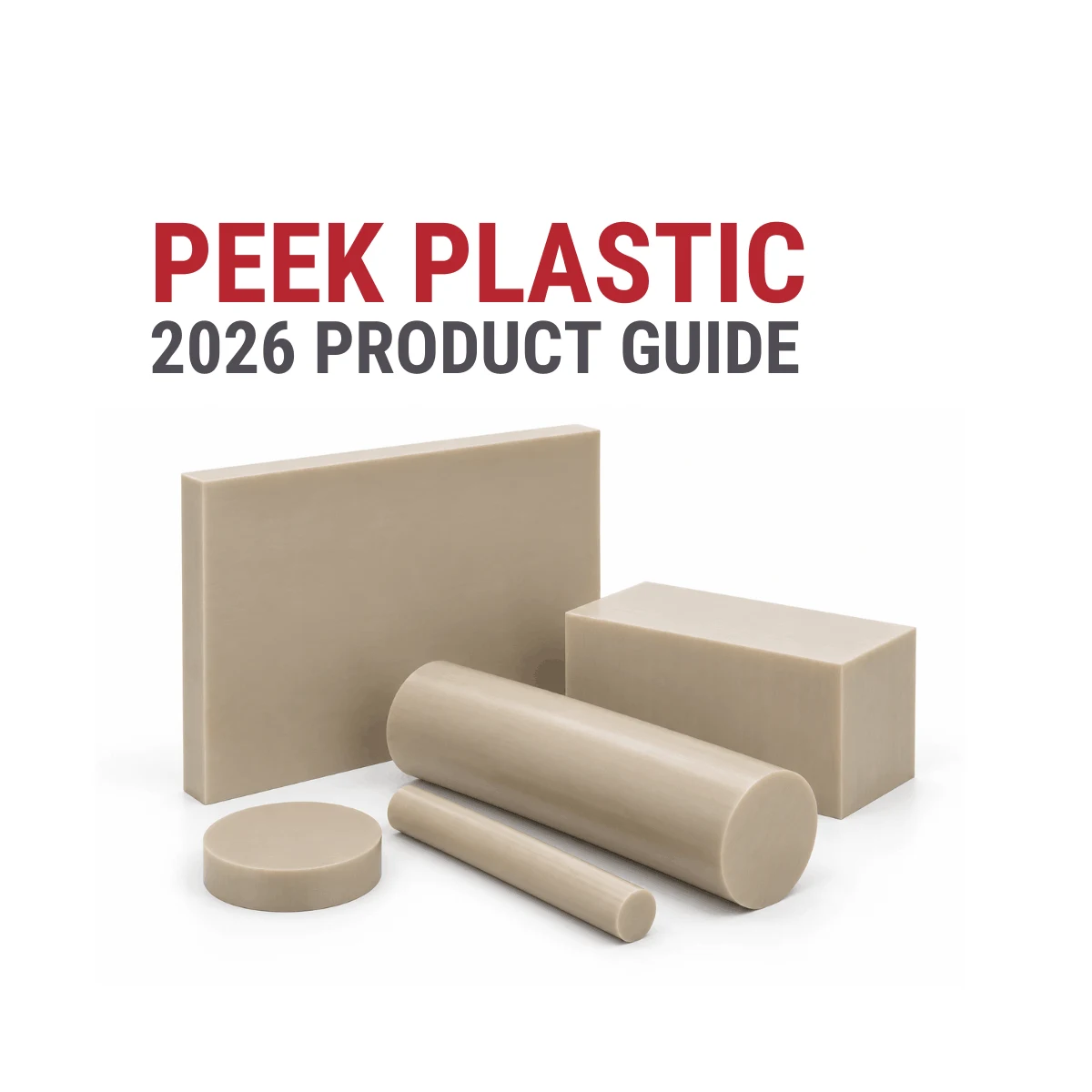
PEEK (polyetheretherketone) is a high-performance engineering thermoplastic rated for continuous use up to 260°C (500°F), with excellent resistance to chemicals, fatigue, and repeated sterilization. Engineers specify it when metal is too heavy or standard plastics can’t survive the heat or chemical exposure, making it a staple in aerospace, medical, and oil & gas components.
Key Properties of PEEK
| Property | Value |
|---|---|
| Melting point | 343°C (649°F) |
| Glass transition temperature | 143°C (289°F) |
| Continuous use temperature | Up to 260°C (500°F) per UL 746B, varies by grade and manufacturer |
| Chemical resistance | Excellent vs. hydrocarbons, organic solvents, acids, strong bases |
| Tensile strength (carbon-fiber-reinforced) | ~29,000 psi, retained at up to 299°C |
| Young’s modulus (unfilled) | 3.5–3.9 GPa |
| Sterilization rating | Up to 3,000 autoclave cycles at 134°C, varies by grade |
PEEK Grades: Unfilled, Glass-Filled & Bearing Grade
Like most engineering plastics, PEEK isn’t a single formulation. The grade matters as much as the base polymer for whether a part actually performs the way you expect:
- Unfilled (virgin) PEEK is naturally abrasion resistant and gives you the material’s baseline chemical and mechanical properties. It’s the default starting point unless an application calls for something more specialized.
- Glass-filled PEEK offers enhanced mechanical and thermal properties compared to unfilled PEEK, plus excellent resistance in harsh chemical environments, and it’s electrically insulative. A common choice for structural components exposed to both heat and chemicals.
- Bearing-grade PEEK is formulated with wear-enhancing additives for applications where the part is a bearing or wear surface rather than a structural component.
Confirm which grade Calsak has in stock for your application before finalizing a spec. Grade availability varies by branch.
Why PEEK Outperforms Standard Engineering Plastics
PEEK’s continuous use temperature of up to 260°C is meaningfully higher than comparable high-performance plastics. PPS tops out around 240°C and PES around 180°C, which is why PEEK gets specified when a part has to hold its mechanical properties under sustained heat that would soften or degrade other engineering plastics. Add excellent creep resistance and fatigue performance, and PEEK becomes the choice for parts under sustained load at elevated temperature, not just brief heat exposure.
Industries That Rely on PEEK
- Aerospace: engine components, structural elements, and cable insulation requiring strength and fire-safety compliance. PEEK’s strength-to-weight ratio helps reduce part mass compared to metal alternatives.
- Medical devices: surgical instruments and implantable components rated for up to 3,000 autoclave sterilization cycles, which matters for reusable instruments in high-turnover surgical environments.
- Oil & gas: downhole seals, bearings, and pressure-resistant components that have to hold up to both heat and aggressive chemical exposure at depth.
- Semiconductor: electrical connectors and chemical-processing equipment, where PEEK’s insulating properties and chemical resistance both matter.
- Automotive: under-the-hood components including piston units, seals, washers, and bearings that see sustained heat cycling.
Machining and Fabricating PEEK
PEEK is easy to machine and fabricate with standard shop tooling, which is one reason it’s a practical choice even though the raw material cost is high. Shops don’t need specialized equipment to turn stock PEEK into finished parts. As with any high-performance plastic, sharp tooling and the right speeds and feeds for the specific grade (filled vs. unfilled) will produce the best finish and dimensional accuracy. Confirm machining parameters with your fabricator for the grade you’re specifying.
PEEK vs. Acetal vs. Nylon: Choosing the Right Engineering Plastic
| Factor | PEEK | Acetal (Delrin) | Nylon |
|---|---|---|---|
| Continuous use temp | Up to 260°C (500°F) | ~90–100°C | ~80–120°C, grade-dependent |
| Chemical resistance | Excellent, broad-spectrum | Good vs. solvents; weak vs. strong acids | Moderate; absorbs moisture |
| Relative cost | Highest by a wide margin | Moderate | Low to moderate |
| Typical use case | Aerospace, medical implants, downhole tools | Bushings, gears, precision parts | Bearings, bushings, general wear parts |
Shop the underlying materials on our Engineering Plastics page, which covers PEEK, acetal, nylon, and more, or browse the full plastic materials catalog.
PEEK in Additive Manufacturing (3D Printing)
PEEK isn’t limited to machined stock shapes. It can also be 3D printed, using either FFF (fused filament fabrication) or SLS (selective laser sintering). But printing PEEK is a different challenge than printing standard filaments. The same high melting point and thermal stability that make PEEK valuable in service also make it difficult to process. Roughly 85% of printers marketed as capable of handling high-performance polymers can’t reliably print PEEK, and 77% fall short on ULTEM 1010 specifically. The chamber and nozzle temperatures required are simply outside what most “high-temp” desktop printers, and even many industrial ones, can sustain.
That gap matters when you’re evaluating a quote for an additively manufactured PEEK part. Ask specifically what printer and process the shop is using, not just whether they “can print PEEK.” Where it’s done correctly, 3D-printed PEEK is gaining real traction in aerospace, biomedical, automotive, industrial, oil & gas, and electrical applications, typically for complex geometries, low-volume production, or parts where machining from bar stock would waste expensive material. For high-volume or simpler geometries, machined PEEK from rod or sheet stock remains the more economical route.
FAQs
What does PEEK stand for?
Polyetheretherketone. It’s one of the polyaryletherketone (PAEK) family of high-performance thermoplastics.
Why is PEEK so expensive compared to other plastics?
PEEK costs significantly more than commodity and mid-range engineering plastics because of its raw material and processing costs. It earns that premium in applications where a part must hold mechanical properties at sustained high temperature, resist aggressive chemicals, or survive thousands of sterilization cycles, conditions that would fail cheaper plastics or require much heavier metal parts.
What’s the difference between unfilled and glass-filled PEEK?
Unfilled PEEK is naturally abrasion resistant and covers most general applications. Glass-filled PEEK adds enhanced mechanical and thermal properties along with electrical insulation, making it better suited to structural parts exposed to both heat and chemicals.
Can PEEK replace metal parts?
In many cases, yes. PEEK is used to replace metal in aerospace, automotive, and medical applications where weight reduction matters and the part’s temperature and load requirements fall within PEEK’s performance range.
Is PEEK safe for medical implants?
PEEK is widely used in medical devices and implantable components and is commonly rated for repeated autoclave sterilization, up to 3,000 cycles for some grades, though the exact figure varies by manufacturer and formulation. Specific implant applications require medical-grade PEEK and regulatory clearance for the intended use. Confirm grade and certification requirements for any implant application.
How does PEEK compare to PPS or PES?
PEEK has a higher continuous use temperature (up to 260°C) than both PPS (around 240°C) and PES (around 180°C), making it the choice when a part needs to hold performance at the highest sustained temperatures among this group of high-performance plastics.
Is PEEK difficult to machine?
No. PEEK is considered easy to machine and fabricate with standard shop tooling, which helps offset its higher material cost since it doesn’t require specialized equipment.
What is bearing-grade PEEK used for?
Bearing-grade PEEK includes wear-enhancing additives and is formulated specifically for applications where the part functions as a bearing or wear surface rather than a structural component.
Does Calsak stock PEEK?
Yes. PEEK is available as part of Calsak’s engineering plastics line. Contact your local branch to confirm grade, form, and lead time for your project.
Can PEEK be 3D printed?
Yes, via FFF or SLS processes, but it requires specialized equipment. Roughly 85% of printers marketed for high-performance polymers can’t reliably print PEEK. Confirm the specific printer and process a shop uses before ordering an additively manufactured PEEK part.
Source PEEK Through Calsak Plastics
Calsak stocks PEEK as part of its engineering plastics line for aerospace, medical, and high-performance industrial applications. View engineering plastics availability or contact your nearest branch to request a quote.

About the Author
B Decker is a Digital Content Specialist working with Calsak Plastics, with five years of focused content production for the industrial plastics distribution sector and a decade of broader industrial-sector writing experience. B’s work covers materials science explainers, fabrication and machining guidance, specification support, and application case studies across thermoplastics, engineering plastics, and composites.
For specification support, sample requests, or material certification documents, contact your local Calsak Plastics location.

Leave a Reply