
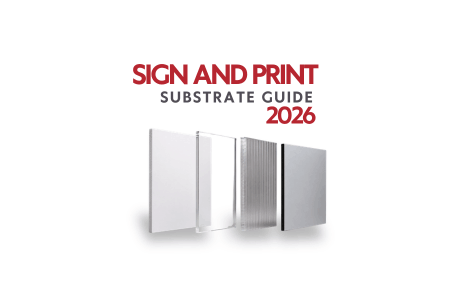
Expanded PVC, Acrylic, Polycarbonate, and ACM for Graphics Projects
Choosing the right sign printing substrates is the single most important decision in any sign or print project. The wrong material fades, warps, cracks, or fails inspection within months. The right one delivers years of clean visuals, predictable fabrication, and a lower cost per year of service.
This guide compares the four substrates that account for the vast majority of rigid sign and print work across the U.S. market: expanded PVC, acrylic, polycarbonate, and ACM (aluminum composite material). Each has a clear sweet spot. Each has limits worth knowing before you cut your first sheet.
Quick Answer
Use expanded PVC for budget indoor and short-term outdoor graphics. Use acrylic for premium interior branding and illuminated signs. Use polycarbonate where impact resistance or vandalism is a real concern. Use ACM for long-term, building-mounted, and exterior wayfinding signage.
How to Choose the Right Sign Printing Substrate
The Short Answer
Sign Printing Substrate selection comes down to four variables: environment, lifespan, mounting method, and brand aesthetic. Get those four right and the material almost picks itself. Print method and fabrication tooling then narrow the final spec.
Key Questions to Ask Before You Choose
Before specifying a material, work through this short checklist:
- Where will the sign live? Indoor, sheltered outdoor, or full sun and weather exposure.
- How long does it need to last? Days, a season, a few years, or a decade-plus.
- What's the mounting method? Wall adhesive, standoffs, post-and-panel, hanging, or freestanding frame.
- What impact or abuse risk is realistic? Foot traffic, vehicle proximity, vandalism, or weather events.
- What aesthetic does the brand require? Matte budget print, glossy premium feel, glass-like clarity, or architectural metal.
- How will it be printed and fabricated? Direct flatbed, UV, applied vinyl, screen print, CNC routing, drilling, or bending.
Answering these before you compare materials saves rework later.
Decision Factors at a Glance
Expanded PVC for Sign and Print Projects
The Short Answer
Expanded PVC is the workhorse of indoor and short-term outdoor signage. It's a closed-cell rigid PVC foam board — lightweight, easy to cut, and well-suited to flatbed and UV printing. For budget-driven projects, nothing else competes on cost per square foot.
What Is Expanded PVC?
Expanded PVC is a rigid, closed-cell foam sheet made from polyvinyl chloride. Common trade names include Sintra, Komatex, and Celtec. It's dense enough to hold screws and route cleanly, but light enough to mount with adhesive or hang from light hardware.
Key Properties and Benefits
- Lightweight — Roughly one-third the weight of a comparable acrylic sheet.
- Easy to fabricate — Cuts with standard woodworking blades, routes cleanly on CNC.
- Print-friendly — Accepts direct flatbed, UV, and screen printing as well as applied vinyl.
- Affordable — The lowest cost per square foot of the four substrates in this guide.
- Wide format availability — Stocked in thicknesses from roughly 1mm to 25mm and standard 4×8 ft sheets.
Best Applications for Expanded PVC
- Indoor retail signage and POP displays
- Menu boards and wayfinding
- Trade show graphics and event signage
- Real estate signs and short-term outdoor promotions
- Backers for vinyl letters, dimensional logos, and digital prints
Limitations and When Not to Use It
Expanded PVC is not the right choice for long-term harsh outdoor installations. Prolonged UV exposure can cause yellowing on white sheets, and thermal cycling can lead to mild warping on large unsupported panels. It is also more flexible than ACM at the same thickness, so larger formats need a frame or stiffener.
Skip expanded PVC for high-impact environments — it will dent and crease under sharp force, and it is not vandal-resistant.
Fabrication and Installation Tips
- Use carbide-tipped blades and standard router bits. Wood-shop feeds and speeds apply.
- Support thin sheets fully during cutting to prevent flex.
- Mount with VHB tape, standoffs, screws, or hook-and-loop depending on weight and surface.
- For panels larger than 4×4 ft, plan for stiffening if the install is unsupported in the middle.
Explore expanded PVC sheet options from Calsak Plastics for stocked thicknesses and sheet sizes.
Acrylic for Sign and Print Projects
The Short Answer
Acrylic is the substrate of choice when appearance matters. Its optical clarity, gloss, and color depth elevate any brand application — from lobby signs to illuminated cabinets. It costs more than PVC, but it looks like it.
What Is Acrylic Sheet?
Acrylic, technically polymethyl methacrylate (PMMA), is a rigid thermoplastic available in cast and extruded forms. Cast acrylic offers superior optical quality, edge finish, and machinability. Extruded acrylic is more economical and better suited to thermoforming. Common trade names include Plexiglas, Acrylite, and Lucite.
Key Properties and Benefits
- Outstanding optical clarity — Light transmission around 92 percent in clear sheet.
- Wide color and finish range — Clear, frosted, mirrored, colored, fluorescent, and edge-lit grades.
- Good outdoor stability — Maintains color and clarity longer than most clear plastics under UV.
- Print-versatile — Accepts flatbed, UV, screen printing, vinyl, and second-surface graphics for protected color.
- Cleaner, more premium aesthetic — The default for brand-forward and architectural applications.
Best Applications for Acrylic
- Corporate lobby and reception signage
- Illuminated and edge-lit cabinets
- Wayfinding in retail and hospitality
- Premium point-of-purchase displays
- Award plaques and dimensional logos
- Protective sneeze guards and dividers
Limitations and Considerations
Acrylic is more brittle than PVC or polycarbonate. It can crack at drill holes, fastener points, or on impact — especially in cold conditions. It also scratches more easily than ACM and costs noticeably more than expanded PVC at the same thickness.
Cast acrylic is harder to thermoform than extruded but yields better optical results. Match the grade to the fabrication method.
Fabrication and Installation Tips
- Use sharp acrylic-specific drill bits with the cutting edge ground for plastic. Standard wood bits chip and crack acrylic.
- Leave protective masking on during all cutting, drilling, and handling.
- Allow for thermal expansion — about 1/8 inch per 4 ft of panel length for typical temperature swings.
- Edge-finish with flame polishing, diamond polishing, or buffing for premium presentation.
- Mount with standoffs, edge grips, or VHB tape; avoid over-torquing fasteners.
Browse acrylic sheet for signage at Calsak Plastics for clear, colored, and specialty grades.
Polycarbonate for Sign and Print Projects
The Short Answer
Polycarbonate is the answer when impact resistance is non-negotiable. It is roughly 200 times stronger than glass and significantly tougher than acrylic at equivalent thickness. If a sign might get hit, kicked, or attacked, polycarbonate belongs on the spec sheet.
What Is Polycarbonate Sheet?
Polycarbonate is a tough, transparent thermoplastic produced in cast, extruded, and multiwall forms. Common trade names include Lexan, Makrolon, and Tuffak. Standard sheet is highly impact-resistant; UV-stabilized grades are required for outdoor signage.
Key Properties and Benefits
- Extreme impact resistance — Significantly outperforms acrylic and PVC under sudden load.
- Wide service temperature range — Performs well from sub-zero to roughly 240°F.
- Good optical clarity — Slightly less than acrylic, but more than adequate for most signage.
- Flame-resistant grades available — Useful for transit, institutional, and code-driven applications.
- Formability — Can be cold-bent or thermoformed without cracking.
Best Applications for Polycarbonate
- Transit and station signage
- Sign faces in high-traffic or vandal-prone areas
- Protective covers over printed graphics
- Outdoor menu boards near drive-thrus
- Schools, recreation facilities, and parking structures
- Hurricane-prone signage where impact matters
Limitations and Considerations
Standard polycarbonate is not UV-stable. Without a coextruded UV layer or surface treatment, it will yellow and lose clarity outdoors within a few years. Always spec UV-grade polycarbonate for any outdoor application.
Polycarbonate also scratches more easily than acrylic. Hard-coated grades are available when scratch resistance is critical. Cost is typically higher than acrylic at the same thickness.
Fabrication and Installation Tips
- Use sharp carbide tooling. Polycarbonate is gummy and dulls dull bits fast.
- Drill with proper feed pressure; chip evacuation matters.
- Account for higher thermal expansion than acrylic — plan oversized fastener holes.
- Keep masking on through fabrication to protect the surface.
- Bond with proper polycarbonate adhesives or mechanical fasteners; many standard adhesives will craze the surface.
See polycarbonate sheet options at Calsak Plastics for UV-grade and hard-coated specs.
ACM (Aluminum Composite Material) for Sign and Print Projects
The Short Answer
ACM is the gold standard for long-term outdoor signage. Two thin aluminum skins bonded to a polyethylene core produce a rigid, dimensionally stable panel that handles weather, UV, and large formats without warping. For building signs, wayfinding, and exterior branding, it is hard to beat.
What Is ACM?
ACM, also called aluminum composite panel (ACP) or by trade names like Dibond, Alumalite, and Alupanel, consists of two pre-painted aluminum sheets bonded to a polyethylene or fire-rated mineral core. Standard sheet thickness is 3mm or 4mm, with various face thicknesses depending on grade.
Key Properties and Benefits
- Exceptional dimensional stability — Holds flat at large formats with minimal expansion or warping.
- Excellent outdoor durability — Manufacturer warranties on factory-painted finishes typically run 10+ years.
- Lightweight relative to solid aluminum — Easier to handle and install on large signs.
- Smooth, factory-finished printable surface — Accepts direct UV print, screen print, and vinyl.
- Available in many colors and finishes — White, black, brushed, anodized, custom paint, and reverse-printable cores.
Best Applications for ACM
- Building-mounted business identification signs
- Post-and-panel wayfinding (parking, campuses, hospitals)
- Pylon and monument sign faces
- Architectural cladding panels (with appropriate engineering)
- Long-term outdoor real estate and development signage
- Large-format directional and regulatory signs
Limitations and Considerations
ACM costs more per square foot than expanded PVC, though typically less than premium cast acrylic in equivalent formats. It is not designed for edge-lit or backlit illumination — it's opaque. And the polyethylene core has fire performance considerations: in code-driven exterior cladding, fire-rated (FR) cores may be required.
ACM is not designed to be bent freely. Routing a V-groove on the back face is the standard method for crisp 90-degree folds.
Fabrication and Installation Tips
- Cut from the back side when possible to protect the painted face.
- Use sharp aluminum or composite-specific blades and bits.
- For folded panels, V-groove the core and back skin, then bend over the front skin.
- Pre-drill fastener holes oversized for thermal movement on outdoor installations.
- Use color-matched edge tape or fabricated returns to finish edges on exposed installs.
Check stocked ACM sign panels at Calsak Plastics for color, thickness, and core options.
Material Comparison: Expanded PVC vs Acrylic vs Polycarbonate vs ACM
The Short Answer
Expanded PVC wins on cost. Acrylic wins on optical clarity and illumination. Polycarbonate wins on impact resistance. ACM wins on long-term outdoor durability. Match the strength to the application — there's no single "best" substrate.
Side-by-Side Comparison Table
| Attribute | Expanded PVC | Acrylic | Polycarbonate | ACM |
|---|---|---|---|---|
| Best for | Budget indoor, short-term outdoor | Premium indoor, illuminated | Impact and vandal resistance | Long-term outdoor panels |
| Relative cost | $ | $$–$$$ | $$–$$$ | $$ |
| Outdoor lifespan | Short to medium | Medium to long | Medium to long (UV grade) | Long |
| Impact resistance | Low | Low (brittle) | Very high | High |
| Optical clarity | Opaque | Excellent | Very good | Opaque |
| Weight per sq ft (3mm) | ~0.4 lb | ~0.75 lb | ~0.85 lb | ~0.55 lb |
| Tool requirements | Wood tools | Sharp plastic-grade tools | Sharp carbide tools | Aluminum/composite tools |
| Backlit suitable | No | Yes | Yes | No |
Which Substrate Should You Choose? Common Scenarios
- Budget indoor POP, menu boards, event signage → Expanded PVC
- Premium lobby, retail, and architectural interior signs → Acrylic
- Illuminated cabinets and edge-lit graphics → Acrylic (polycarbonate if impact is a factor)
- Drive-thrus, transit, schools, vandalism risk → Polycarbonate (UV grade outdoors)
- Building signs, wayfinding, post-and-panel exterior → ACM
- Long-term outdoor real estate or development signage → ACM
- Protective covers over printed graphics → Polycarbonate
Application-Based Recommendations
Indoor Retail and POP Graphics
For high-volume, fast-turn retail prints, expanded PVC wins on cost and ease of fabrication. When the brand calls for a premium feel — flagship stores, hospitality, corporate offices — acrylic delivers the visual quality that justifies the higher price. Pair second-surface printed acrylic with standoffs for a clean architectural look.
Outdoor Wayfinding, Parking, and Facility Signs
ACM is the default for parking, campus, and facility signage. It handles weather, large formats, and post-and-panel mounting cleanly. Polycarbonate enters the spec when impact resistance matters — parking garage clearances, transit shelters, and ground-level signs near vehicles. Reserve expanded PVC for sheltered or short-term outdoor only.
Illuminated and Backlit Graphics
Acrylic dominates illuminated signage. White and opal acrylic provide even light diffusion in cabinets, channel letters, and edge-lit displays. Use polycarbonate faces when impact protection or code requirements force the switch — though expect slightly lower optical clarity and a higher initial cost.
Cost, Durability, and Total Cost of Ownership
The Short Answer
Cheap substrate plus short lifespan often costs more than a premium panel that lasts a decade. Once you factor in replacement labor, downtime, and refabrication, ACM and polycarbonate frequently deliver lower cost per year for long-term outdoor signage than expanded PVC.
Upfront Cost vs Lifespan
Expanded PVC has the lowest upfront cost but the shortest outdoor service life. For a 6-month outdoor campaign, it's the right call. For a 10-year exterior building sign, ACM costs more upfront but delivers a far lower cost per year of service once you factor in replacement labor and downtime.
The math usually favors stepping up to ACM or polycarbonate any time the sign is expected to last beyond 2 years outdoors. The replacement cost — pulling the old sign, refabricating, reinstalling — typically dwarfs the substrate cost difference.
Environmental and Maintenance Factors
- UV exposure — Direct sun degrades non-UV-stable plastics. Always spec UV-grade polycarbonate outdoors. Confirm warranty terms on factory-painted ACM finishes.
- Temperature swings — All four materials expand and contract. Plan fastener holes and frame clearances accordingly.
- Cleaning — Avoid ammonia-based cleaners on polycarbonate and acrylic; they craze the surface. Mild soap and water with a soft cloth is the safe default across all four substrates.
- Vandalism and high-traffic abuse — Polycarbonate or hard-coated polycarbonate is the realistic answer.
Working With Calsak Plastics on Your Next Sign or Print Project
Stocked Sheet Sizes, Colors, and Finishes
Calsak Plastics stocks expanded PVC, acrylic, polycarbonate, and ACM in industry-standard sheet sizes and a full range of thicknesses for sign and print fabrication across the United States. Standard 4×8 ft sheets are inventoried for fast turnaround, with larger formats and specialty colors available on request.
Technical Support and Material Selection Help
Designers, sign shops, and fabricators can speak with a Calsak materials specialist for help matching substrate to application. Bring the use case — environment, lifespan, mounting method, and budget — and a specialist can recommend the right material, grade, and thickness.
Requesting Quotes and Samples
Cut samples, manufacturer data sheets, and volume pricing are available on request. For ongoing print and sign production, Calsak can set up program pricing and stocking arrangements to keep your shop running without stockouts.
Need help choosing a substrate?
Talk to a Calsak materials specialist about your next sign or print project. Cut samples and data sheets available on request.
Request a QuoteFrequently Asked Questions
What is the best substrate for outdoor signs?
ACM is generally the best substrate for long-term outdoor signs. Two aluminum skins bonded to a stable core deliver excellent UV resistance, dimensional stability, and weather durability — typically 7 to 10+ years of outdoor service with a factory-painted finish.
When should I use expanded PVC instead of acrylic for signs?
Use expanded PVC when budget, weight, and fabrication speed matter more than premium appearance. It is ideal for indoor signage, short-term outdoor graphics, and projects where impact and brand polish are not critical. Choose acrylic when you need clarity, gloss, or illuminated signage.
Is acrylic or polycarbonate better for illuminated signage?
Acrylic is preferred for most illuminated signage because of its superior optical clarity and gloss. Choose polycarbonate when impact resistance or code requirements override the aesthetic — for example, transit shelters, vandal-prone locations, or hurricane-rated installations.
How long do PVC signs last outdoors?
Expanded PVC signs typically last 6 months to 2 years outdoors, depending on exposure, sheet thickness, and graphic durability. For multi-year outdoor service in direct sun and harsh weather, ACM or UV-grade polycarbonate provide significantly longer performance.
Can I print directly onto ACM, PVC, acrylic, and polycarbonate?
Yes — all four substrates accept direct flatbed and UV printing with appropriate inks and surface prep. They also work with applied vinyl graphics. Acrylic supports second-surface (reverse) printing for protected, high-end visuals. Polycarbonate may require surface treatment for some ink systems.
Which sign substrate is most impact-resistant?
Polycarbonate is the most impact-resistant of the four. It is roughly 200 times stronger than glass and significantly tougher than acrylic at the same thickness. It is the standard choice for high-traffic, vandal-prone, and security-sensitive signage.
Are acrylic signs more expensive than PVC signs?
Yes — acrylic costs roughly two to three times more per square foot than expanded PVC at comparable thicknesses. The premium reflects acrylic's optical clarity, finish quality, and durability, making it the right choice for brand-forward and illuminated applications rather than budget signage.
What thickness should I choose for rigid sign panels?
Thickness depends on panel size, mounting method, and wind load. Common choices: 3mm or 6mm expanded PVC for small to medium indoor signs, 3mm or 4mm ACM for most outdoor panels, 1/8 to 1/4 inch acrylic for lobby and illuminated signs, and 1/8 to 1/4 inch polycarbonate for impact-rated faces.
Can ACM panels be used indoors?
Yes — ACM works well indoors and outdoors. Its rigid, lightweight panel format makes it especially useful for large wall-mounted signs, donor walls, and post-and-panel directional systems where dimensional stability and a clean architectural look matter.
How do I choose between PVC, acrylic, polycarbonate, and ACM for my project?
Start with four questions: where the sign will live, how long it must last, what impact risk it faces, and what brand look you need. Match those answers to each material's strengths — PVC for budget indoor, acrylic for premium and illuminated, polycarbonate for impact, ACM for long-term outdoor.
Are these sign substrates recyclable?
Recyclability varies by material and local infrastructure. PVC, acrylic, and polycarbonate have dedicated recycling streams in many regions. ACM recycling requires separating the aluminum skins from the polyethylene core, which is feasible at specialized recyclers but not universally available.
Do I need special tools to cut and drill these substrates?
Expanded PVC cuts cleanly with standard woodworking tools. Acrylic and polycarbonate require sharp, plastic-specific drill bits and blades to prevent chipping and cracking. ACM is cut with aluminum or composite-specific tooling, and back-side cutting is recommended to protect the painted face.
Bottom Line
Substrate selection is rarely about finding the "best" material — it's about matching the right material to the job. Expanded PVC, acrylic, polycarbonate, and ACM each own a clear use case:
- Expanded PVC — economy, indoor, short-term
- Acrylic — premium, illuminated, brand-forward
- Polycarbonate — impact, security, abuse
- ACM — long-term, outdoor, large-format
Spec the material to the environment, the lifespan, the mounting method, and the brand. Get those four right, and the sign will outlast its design brief.

Leave a Reply