
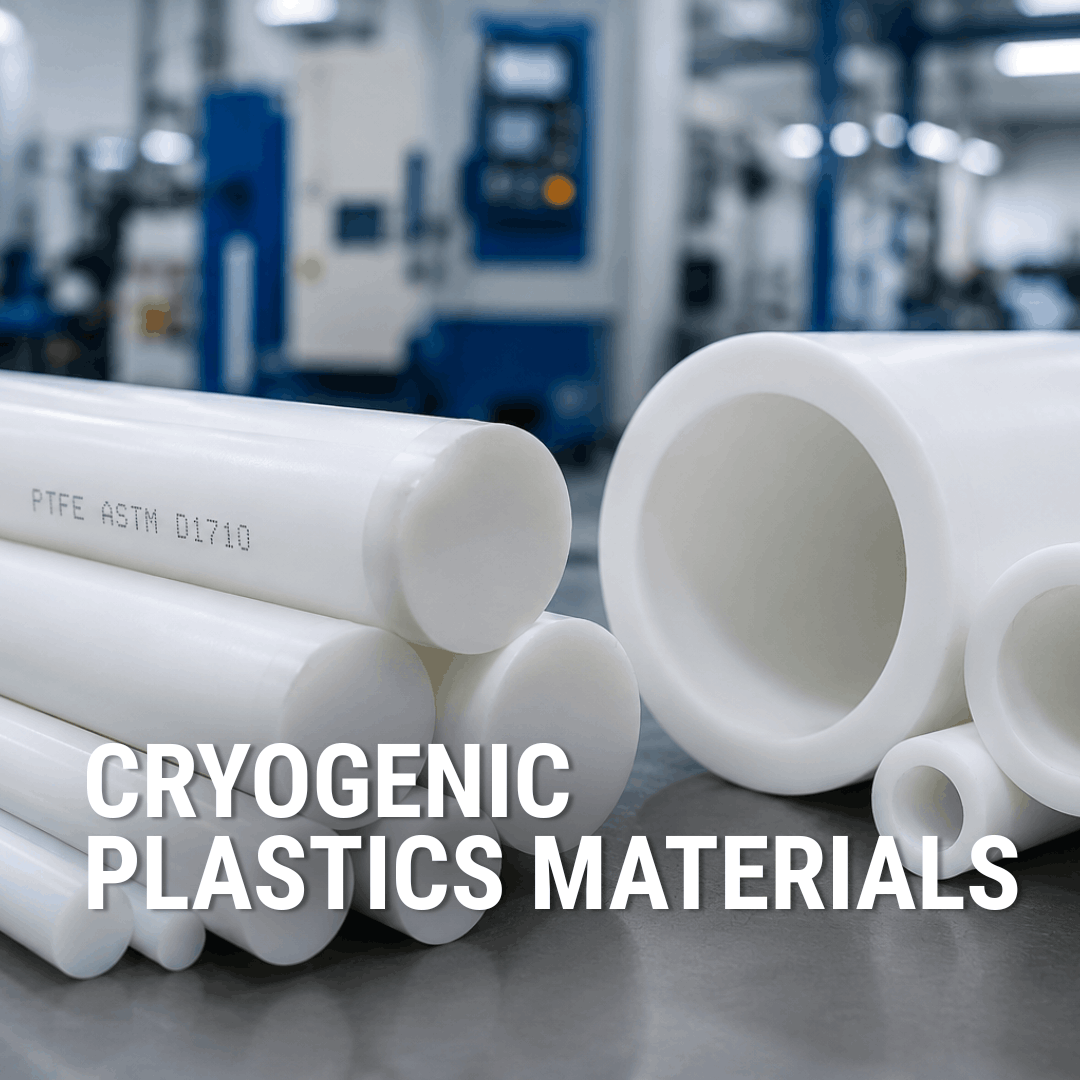
Cryogenic Plastics Materials: Engineering Guide to PTFE, PFA, PVDF, PE & ABS at Extreme Low Temperatures
Engineers specifying components for liquid nitrogen tanks, LNG transfer lines, MRI systems, superconducting magnets, and aerospace propellant handling face the same problem: most plastics become brittle and fracture under load when cooled to cryogenic temperatures. A small group of high-performance polymers behaves differently. They retain ductility, hold tolerance, and maintain sealing force well below the temperatures where standard engineering plastics fail.
This guide compares the cryogenic plastics that matter most in industrial service — PTFE, PFA, PVDF, polyethylene, and ABS — with the performance data, design considerations, and selection criteria engineers need to specify them correctly the first time.
Key Takeaways
- PTFE and PFA retain ductility down to roughly −250 °C and are the standard choices for cryogenic seals, valves, and tubing.
- UHMW-PE outperforms standard HDPE at cryogenic temperatures and is preferred for bearings, wear surfaces, and tank liners in LNG service.
- PVDF covers cryogenic chemical processing where chemical resistance and structural rigidity matter more than maximum low-temperature service.
- ABS is not a cryogenic material in continuous service — it becomes brittle below −40 °C. Engineers should default to UHMW-PE or a fluoropolymer instead.
- Design for cryogenic plastics requires accounting for thermal contraction 5–10× greater than steel, gas permeability under high pressure, and ductile-to-brittle transition behavior.
What are cryogenic plastics materials?
Cryogenic plastics materials are thermoplastics that retain mechanical and chemical performance at temperatures below −150 °C. They are used wherever a system stores, transports, or processes liquefied gases including liquid nitrogen (−196 °C), liquid oxygen (−183 °C), liquefied natural gas (−162 °C), liquid hydrogen (−253 °C), or liquid helium (−269 °C). Common applications include valve seats, gaskets, tubing, bearings, electrical insulators, and structural supports inside cryostats and dewars.
The polymers that perform in this range share three properties: a glass transition temperature low enough that the material does not become brittle in service, a relatively low coefficient of thermal expansion compared with other plastics, and chemical inertness to the cryogenic fluid being handled.
How is “cryogenic temperature” defined for plastics?
In plastics engineering, cryogenic temperature is generally defined as the range below −150 °C (−238 °F). This threshold corresponds to the practical lower limit where most engineering thermoplastics either remain functional or fail. The boiling points of common industrial cryogens fall well below this line: nitrogen at −196 °C, oxygen at −183 °C, hydrogen at −253 °C, and helium at −269 °C.
The ASTM D746 brittleness test and the equivalent ISO 974 test are the two most widely cited methods for quantifying low-temperature performance. Both measure the temperature at which 50% of a tested population of plastic specimens fails under impact — a useful but conservative benchmark. Engineers designing for cryogenic service typically require service temperature ratings well below the brittleness temperature, with margin for thermal cycling and impact loads.
What happens to plastic at cryogenic temperatures?
When cooled toward cryogenic temperatures, plastics generally become stiffer, stronger in tension, and harder. Tensile strength and modulus typically increase. The trade-off is a reduction in impact resistance and elongation at break. For most plastics, this means a transition from ductile to brittle behavior somewhere between 0 °C and −100 °C, after which the material fails in a brittle manner under impact rather than yielding.
A narrow class of polymers does not follow this pattern. PTFE, PFA, and ultra-high molecular weight polyethylene retain useful ductility well below −150 °C. Their molecular structure prevents the formation of the rigid crystalline regions that cause brittle failure in other thermoplastics. This is why fluoropolymers and UHMW-PE dominate cryogenic component design: not because they are the only plastics that survive the temperature, but because they are the only plastics that survive it while still absorbing impact and accommodating thermal contraction without cracking.
Which plastics work at cryogenic temperatures?
Five material families cover the majority of cryogenic plastic applications: polytetrafluoroethylene (PTFE), perfluoroalkoxy (PFA), polyvinylidene fluoride (PVDF), polyethylene (HDPE and UHMW-PE), and acrylonitrile butadiene styrene (ABS). The comparison table below summarizes the performance ranges that drive selection between them.
| Property | PTFE | PFA | PVDF | HDPE / UHMW-PE | ABS |
|---|---|---|---|---|---|
| Low service temp | −200 to −250 °C | −200 to −260 °C | −50 °C (standard) to lower with specific grades | −100 °C (HDPE) / −200 °C (UHMW-PE) | −40 °C |
| Ductile at LN₂ (−196 °C) | Yes | Yes | Grade-dependent | Yes (UHMW-PE); No for standard HDPE below −80 °C | No (brittle) |
| LOX compatibility | Yes (best-in-class) | Yes | Acceptable; less common than PTFE/PFA | No | No |
| Chemical resistance | Excellent | Excellent | Excellent | Good | Limited |
| Gas permeability | Higher | Lower than PTFE | Low | Moderate | Moderate |
| Machinability | Good (low cutting forces) | Good | Excellent | Excellent | Good |
| Typical cryogenic use | Seals, valve seats, gaskets, LNG loading arms | Tubing, fittings, high-purity gas lines | Pump components, chemical lines, structural parts | Bearings, wear parts, tank liners (UHMW-PE) | Short-duration ambient handling only |
Service temperature ranges shown are typical for industrial grades. Always confirm specific values against the resin manufacturer’s current datasheet at the time of design. The sections below cover each material in more detail.
PTFE for cryogenic applications
PTFE’s molecular structure — a fully fluorinated carbon backbone — gives it one of the widest service temperature ranges of any thermoplastic, typically cited as −200 °C to +260 °C, with documented mechanical function extending to −250 °C and below. Unlike most polymers, PTFE does not undergo a sharp ductile-to-brittle transition in this range; it stiffens but continues to absorb impact and accommodate thermal cycling without cracking.
The material is chemically inert to virtually all industrial fluids, including the strong acids, hydrocarbons, and oxidizers commonly involved in cryogenic process streams. PTFE has the lowest coefficient of friction of any solid material and self-lubricates, which is critical in cryogenic dynamic seals where conventional lubricants would solidify.
PTFE cryogenic seals
PTFE is the standard jacket material for cryogenic spring-energized seals. The seal is built as a composite: a PTFE jacket that contacts the sealing surface, energized by a metallic spring — typically stainless steel — that maintains constant sealing load as the assembly contracts during cooldown. This design compensates for two limitations of pure PTFE: its tendency to cold-flow (creep) under sustained pressure, and the significant dimensional change it undergoes between room temperature and cryogenic service.
Common applications for PTFE cryogenic seals include LNG loading arm swivel joints, cryogenic ball valves, liquid hydrogen and liquid oxygen propellant systems, MRI cryostat seals, and superconducting magnet feedthroughs. In each case, the failure mode being designed against is loss of sealing force during thermal cycling — a problem PTFE handles well because its compression set recovery, while imperfect, is better than most alternatives at cryogenic temperatures.
PTFE is also resistant to explosive decompression. Many polymers absorb gas under pressure, and when system pressure drops rapidly, that gas expands inside the seal material and ruptures it. PTFE’s molecular structure resists this failure mode, making it the preferred jacket material for high-pressure cryogenic gas service.
PTFE limitations engineers should plan for
PTFE has three engineering limitations relevant to cryogenic design. First, it cold-flows under sustained load, particularly at warmer end-of-cycle temperatures. Static seal designs must control compression to prevent gasket extrusion. Second, its coefficient of linear thermal expansion is high — roughly 10× that of steel — so designs with metallic mating surfaces require deliberate clearance accounting for differential contraction. Third, PTFE is more permeable to gases than PFA or PVDF, which matters in high-purity or high-pressure gas containment.
Filled PTFE grades address some of these limitations. Glass-, carbon-, and bronze-filled PTFE compounds offer reduced creep, improved wear resistance, and better dimensional stability than virgin PTFE, at the cost of slightly reduced chemical inertness and a small increase in friction.
Need cryogenic-grade PTFE stock?
Calsak Plastics stocks virgin and filled PTFE in rod, tube, and sheet form across seven U.S. locations. Cut-to-size and CNC machining available with full lot certification for aerospace and medical applications.
Browse PTFE Rod & Tube Stock Request a QuotePFA for cryogenic tubing and high-purity systems
PFA shares PTFE’s broad service temperature range, with typical ratings from −200 °C to +260 °C and documented function to roughly −260 °C. The key chemical difference is the perfluoroalkoxy side group, which makes PFA melt-processable. Unlike PTFE, which must be compression-molded and then machined, PFA can be extruded into continuous tubing, injection-molded into fittings, and welded into seamless assemblies. This processing flexibility translates directly into engineering advantages for cryogenic systems.
PFA’s permeation rate is meaningfully lower than PTFE’s across most gases. In cryogenic systems handling helium, hydrogen, or high-purity process gases, this matters: lower permeability means lower fugitive loss, better vacuum integrity in cryostats, and reduced contamination risk in semiconductor cryo-processing.
PFA cryogenic tubing in semiconductor applications
The semiconductor industry uses PFA tubing extensively for cryogenic and ultra-pure chemical handling. PFA grades certified to SEMI F-57 are produced with controlled extractable levels suitable for sub-micron contamination requirements. In cryogenic semiconductor service — cooling stages for ion implantation, deep-UV lithography optics, and ultra-low-temperature wafer handling — SEMI F-57 PFA tubing combines the chemical inertness needed for corrosive process fluids with the temperature range needed for cryogenic supply lines.
PFA is also translucent, allowing visual inspection of fluid flow without breaking the line. This is operationally significant in cryogenic systems where ice formation, two-phase flow, or contamination would otherwise be invisible.
PFA vs PTFE at cryogenic temperatures
The choice between PFA and PTFE for cryogenic applications depends on the priority. PTFE wins on cost, static seal compression recovery, and absolute chemical inertness. PFA wins on continuous tubing length, lower gas permeability, optical clarity, improved creep resistance, and the ability to fabricate complex shapes through injection molding. Both are LOX-compatible. For sealing applications, PTFE remains the default. For tubing, fittings, and complex molded components in cryogenic service, PFA is typically the better engineering choice despite the higher cost per pound.
PVDF for cryogenic chemical processing
PVDF occupies a different position in the cryogenic material map than PTFE and PFA. It is not a primary choice for deep cryogenic seals or LH₂ service. Where PVDF earns specification is in cryogenic chemical processing systems — pumps, valves, piping components, and structural parts — where the operating environment combines moderate low temperatures with aggressive chemical exposure that would degrade PE or ABS.
PVDF’s mechanical strength is notably higher than PTFE or PFA at room temperature, and the material is significantly more rigid. This makes it a good choice for structural components in cryogenic processing equipment, including pump impellers, valve bodies, and piping supports. PVDF also machines well with conventional tooling, holds tight tolerances, and welds reliably for fabricated assemblies.
Engineers specifying PVDF for cryogenic service should verify the specific grade against the application temperature. General-purpose PVDF is rated to roughly −50 °C; certain modified grades and PVDF copolymers extend service lower, but service-temperature claims vary by manufacturer. When the application requires verified performance below −50 °C, request the grade-specific datasheet and confirm with the resin producer rather than relying on generic PVDF specifications.
Polyethylene (HDPE and UHMW-PE) for cryogenic structural and wear applications
The two materials behave quite differently at cryogenic temperatures. HDPE undergoes a ductile-to-brittle transition around −80 °C in most grades, limiting its use in continuous cryogenic service. UHMW-PE, with its much longer molecular chains and more entangled structure, retains useful ductility and impact resistance to roughly −200 °C. The mechanical strength of UHMW-PE actually increases as temperature drops, while it continues to absorb impact — an unusual combination for a thermoplastic.
UHMW-PE in cryogenic bearings and tank liners
UHMW-PE is the standard material for cryogenic plain bearings, wear strips, and tank liners in LNG and industrial gas service. Its abrasion resistance is exceptional — higher than most metals on a normalized basis — and it self-lubricates under sliding load, eliminating the need for greases that would fail at cryogenic temperatures. The material is also chemically inert to nearly all hydrocarbons, making it well-suited to LNG tank internals and transfer system bearings.
In thermal contraction terms, UHMW-PE behaves similarly to other polyolefins, which means designers must account for substantial dimensional change between installation temperature and cryogenic service. Tank liner installations typically use overlapping panels with thermal expansion gaps rather than welded continuous sheets, allowing the liner to contract and expand without delaminating from the tank wall.
UHMW-PE is not LOX-compatible and should not be used in liquid oxygen service. Hydrocarbon plastics in general are not specified for oxygen-rich environments — that is fluoropolymer territory.
HDPE and UHMW-PE for cryogenic projects
Calsak supplies HDPE and UHMW-PE sheet, rod, and tube stock with fabrication services across the full U.S. footprint. Material certification and traceability available for aerospace and medical applications.
View HDPE Stock & Grades Fabrication ServicesABS at low temperatures — what engineers should know
ABS appears in cryogenic material discussions because of its widespread use in industrial parts and the recognition that engineers may consider it for adjacent applications — ambient-temperature handling of cryogenic containers, short-duration cold exposure, or insulated housings on cryogenic equipment. Outside the cryogenic temperature range proper, ABS is a strong engineering plastic: good impact resistance at room temperature, easy fabrication, and reasonable chemical resistance to many fluids.
The problem in continuous cryogenic service is brittleness. ABS contains a rubber phase that provides its room-temperature toughness, and that rubber phase has a glass transition temperature in the range of −50 °C to −80 °C depending on grade. Below this transition, the rubber loses its energy-absorbing capability and the material becomes notably more susceptible to brittle fracture under impact. For any application where the part is loaded and at cryogenic temperature simultaneously, ABS is the wrong choice.
The correct alternatives are application-dependent. For impact-resistant structural parts in cryogenic service, UHMW-PE. For sealing and tubing, PTFE or PFA. For rigid structural components requiring chemical resistance, PVDF. The cost difference relative to ABS is real, but the reliability difference justifies it in any application where failure carries consequence.
Engineering design considerations for cryogenic plastic components
Material selection is necessary but not sufficient for reliable cryogenic plastic component performance. The following design considerations apply across all the material families discussed above and should be reviewed during specification, not after first prototype.
Thermal contraction and CLTE
Plastics contract considerably more than metals between room temperature and cryogenic temperatures. The coefficient of linear thermal expansion (CLTE) for most engineering plastics falls between 7 and 20 × 10⁻⁵ per °C at room temperature, compared with roughly 1.2 × 10⁻⁵ per °C for stainless steel. Over a 200 °C temperature drop, this differential can translate into millimeters of dimensional change on production-sized parts.
A worked example: a PTFE component with a CLTE of approximately 12 × 10⁻⁵ per °C, dimensioned at 100 mm at 20 °C, will contract by roughly 2.6 mm when cooled to liquid nitrogen temperature (−196 °C). The mating steel surface contracts by roughly 0.26 mm over the same range. That 2.3 mm differential must be accommodated by the design through clearance, compression, or controlled compliance.
In static seal applications, this differential is the reason spring-energized seals exist. The spring maintains compressive load on the polymer jacket as the assembly contracts, preventing leak paths from opening up during cooldown. In bearing applications, designers typically specify the polymer bearing slightly larger than nominal at room temperature, allowing it to contract into operating clearance at cryogenic temperature.
Ductile-to-brittle transition
Every polymer has a temperature below which it transitions from ductile to brittle fracture behavior. For some materials — PTFE, PFA, UHMW-PE — this transition occurs at temperatures well below typical cryogenic service ranges, which is what makes these materials viable. For others — ABS, polycarbonate, standard HDPE — the transition occurs within or above the cryogenic range, ruling them out for sustained low-temperature service.
The transition is quantified primarily by the ASTM D746 brittleness temperature test, which establishes the temperature at which 50% of impact-loaded specimens fail. ISO 974 is the equivalent international method. Both tests provide a useful benchmark but represent impact loading on small, unconstrained specimens; real components under static load or thermal stress may exhibit different transition behavior, which is why brittleness temperature should be used as a screening tool rather than an absolute service limit.
Gas permeability and explosive decompression
In high-pressure cryogenic gas systems, gas permeates into the polymer under operating pressure. If system pressure drops rapidly — through a relief event, planned depressurization, or component failure — the dissolved gas expands inside the polymer faster than it can escape, rupturing the seal material from within. This failure mode, called explosive decompression or rapid gas decompression, is a known cause of seal failure in high-pressure hydrogen, helium, and natural gas service.
PTFE is largely resistant to explosive decompression due to its molecular structure, which limits gas absorption. Elastomers and softer polymers are much more vulnerable. For high-pressure cryogenic gas applications, fluoropolymer seals with metallic energizers are the standard specification.
Sealing design for cryogenic service
Cryogenic seal design follows a few consistent principles. First, use a metallic spring or pressure-energizer to maintain sealing load as the polymer contracts. Second, orient the seal lip so system pressure assists sealing rather than working against it. Third, select the polymer grade and filler combination for the specific service: virgin PTFE for chemical purity, glass-filled PTFE for reduced creep, carbon-filled PTFE for improved wear, bronze-filled PTFE for thermal conductivity in high-friction applications.
For static sealing applications, controlled compression is critical. Over-compression causes the polymer to extrude under cold-flow during thermal cycling; under-compression leaves insufficient sealing load after cooldown contraction. Calculated compression based on operating temperature, not installation temperature, is the right approach.
Testing protocols for cryogenic plastic components
A short list of standard tests covers most cryogenic plastic component qualification:
- ASTM D746 — Brittleness temperature by impact
- ISO 974 — International equivalent of ASTM D746
- ASTM E1450 — Tensile testing of structural materials at cryogenic temperatures using a liquid helium environment
- ASTM D696 — Coefficient of linear thermal expansion measurement
- ASTM G86 — Mechanical impact ignition sensitivity in pressurized oxygen, relevant to LOX-compatibility qualification
- ASTM G63 — Guide for evaluating nonmetallic materials for oxygen service
For aerospace applications, lot-level material certification per AS9100 is typically required, with full traceability from resin lot through finished part. For medical device applications, ISO 13485 traceability and USP Class VI or FDA 21 CFR 177 compliance documentation apply. Cryogenic component fabricators should be able to provide all required certification at quote time, not as an afterthought.
Industry applications for cryogenic plastics
Cryogenic plastics appear across a range of industries, with the specific material and grade selection driven by the operating environment. The following are the most common application areas and the polymers typically specified for them.
Aerospace and space flight hardware
Aerospace applications include liquid hydrogen and liquid oxygen propellant systems, cryogenic insulation for upper-stage tanks, seals in cryogenic propellant pumps and valves, and bushings in actuator systems exposed to space-environment temperatures. PTFE dominates sealing applications because of its LOX compatibility and reliability under thermal cycling. PFA appears in high-purity fluid lines and instrumentation. UHMW-PE is used for bearings and wear components in non-oxidizer service.
Material certification for aerospace cryogenic components typically requires AS9100 traceability, with lot-level documentation linking finished part to resin lot.
Medical equipment and cryopreservation
Medical applications include MRI cryostat seals, cryosurgical instrument components, biological sample storage at liquid nitrogen temperatures, and pharmaceutical processing involving cryogenic chemistry. PTFE and PFA are the dominant materials, with USP Class VI biocompatibility documentation typically required for any component contacting biological samples. Lot traceability per ISO 13485 is standard.
LNG, liquefied gases, and oil & gas
LNG service is one of the largest commercial users of cryogenic plastics. PTFE seals appear in loading arm swivel joints, valve seats, and bunkering connections across the LNG supply chain. UHMW-PE wear components are common inside LNG tanks and transfer systems. PVDF appears in cryogenic processing equipment for natural gas liquids. In each case, the operating temperature is below the brittle transition for most engineering plastics, leaving fluoropolymers and UHMW-PE as the practical options.
Superconducting equipment and particle physics
Superconducting magnets, MRI systems, particle accelerators, and quantum computing hardware all operate at liquid helium temperatures (−269 °C) or below. Plastics in this environment are used for electrical insulation between cooled current-carrying elements, mechanical supports inside cryostats, vacuum-tight feedthroughs, and structural components in cold-mass assemblies. PTFE and PFA are standard for insulation and seals. Glass-reinforced thermoset composites are typically used for structural supports requiring high strength-to-conductivity ratios — outside the scope of this guide.
Semiconductor cryogenic processing
Semiconductor fabrication uses cryogenic plastics in deep-UV lithography optical bench cooling, ion implantation cooling stages, cryo-electronics test equipment, and high-purity gas delivery for low-temperature processes. SEMI F-57 certified PFA tubing is the standard material for cryogenic high-purity chemical lines. The combination of low extractable levels, broad chemical resistance, and cryogenic temperature range makes PFA effectively irreplaceable in this segment.
How to source certified cryogenic plastics materials
Sourcing cryogenic-grade plastic stock involves three considerations beyond price and lead time: material certification with full lot traceability, grade verification for the specific cryogenic application, and the ability to deliver cut-to-size or fabricated components with documentation intact.
Calsak Plastics has supplied engineering plastics to U.S. manufacturers since 1972 from a network of seven branch locations: Los Angeles, Seattle (Kent), Portland, Charlotte, Atlanta (Lawrenceville), Minneapolis, and Irving (Texas). Each branch carries stocking inventory of PTFE, PFA, PVDF, HDPE, UHMW-PE, and other engineering plastics in sheet, rod, and tube form, with cut-to-size service shipping in 1–3 business days from the branch nearest the customer.
For applications requiring lot certification, Calsak’s Kent (Seattle) operation provides material traceability documentation meeting AS9100 aerospace and ISO 13485 medical device quality system requirements. Resin lot, manufacturer datasheets, certificate of compliance, and lot-level test data are available with the shipment, allowing engineers to close their material qualification documentation without additional supplier follow-up.
Cut-to-size, fabrication, and machined parts
Calsak’s in-house fabrication capability extends beyond raw material distribution. CNC routing, CNC drilling, multi-axis machining, thermoforming, edge polishing, and assembly are available across the U.S. footprint, with cryogenic-grade components delivered as finished parts ready for installation. For cryogenic seal blanks, valve seat machining, bearing fabrication, and structural component production, single-source delivery from a stocking distributor with in-house fabrication eliminates the coordination cost of running material through multiple vendors.
Specifying cryogenic plastic components?
Talk to a Calsak engineering plastics specialist before finalizing your bill of materials. We supply PTFE, PFA, PVDF, HDPE, and UHMW-PE stock with full traceability, plus in-house CNC fabrication across seven U.S. locations.
Request a Quote Engineering Plastics CatalogFrequently asked questions about cryogenic plastics materials
What is the best plastic for cryogenic applications?
PTFE and PFA are the two most widely specified cryogenic plastics. PTFE handles continuous service down to approximately −250 °C with excellent sealing performance and liquid oxygen compatibility, while PFA offers similar low-temperature performance with lower gas permeability and better mechanical creep resistance. UHMW-PE is the preferred choice for cryogenic bearings and wear surfaces.
Does PTFE become brittle at cryogenic temperatures?
PTFE does not become brittle at cryogenic temperatures in the way most plastics do. It retains useful ductility down to approximately −250 °C, which is why it remains the standard material for cryogenic valve seats, gaskets, and spring-energized seals in LNG, liquid oxygen, and liquid hydrogen service. The material stiffens but continues to absorb impact and accommodate thermal cycling.
Can plastic be used with liquid nitrogen?
Yes. PTFE, PFA, PVDF, and UHMW-PE are all compatible with liquid nitrogen at −196 °C. PTFE and PFA are most commonly used for seals, tubing, and fittings in LN₂ service. Standard HDPE and ABS are not recommended for direct LN₂ contact due to brittleness, though they may appear in adjacent ambient-temperature handling components.
What is the lowest temperature plastic can handle?
Specialty fluoropolymers including PTFE and PFA maintain mechanical function down to roughly −260 °C, close to liquid helium temperature (−269 °C). At these temperatures plastics become stiffer and stronger but retain useful ductility, which contrasts with most metals and ceramics that can become brittle under impact at the same temperatures.
Is PFA better than PTFE for cryogenic applications?
PFA outperforms PTFE in cryogenic applications requiring low gas permeability, optical clarity for flow inspection, or melt-processability for complex shapes. PTFE outperforms PFA where cost, static seal compression recovery, or maximum chemical resistance is the priority. Both are liquid oxygen compatible. For sealing, PTFE remains the default; for tubing and complex molded parts, PFA is typically preferred.
What plastics are LOX (liquid oxygen) compatible?
PTFE, PFA, FEP, and PCTFE are the four fluoropolymers with documented liquid oxygen compatibility per ASTM G86 testing. These materials resist ignition under LOX impact conditions. Standard hydrocarbon plastics including polyethylene, polypropylene, and ABS are not LOX compatible and must not be used in liquid oxygen service.
How do I account for thermal contraction when designing with cryogenic plastics?
Cryogenic plastics contract 5–10× more than steel between room temperature and −196 °C. Design mating surfaces with clearance rather than interference fits, allow for differential contraction with metallic components, and verify gasket compression under cooled rather than installation conditions. PTFE contracts approximately 2% from 20 °C to −196 °C, which translates to millimeters of dimensional change on production-sized parts.

Leave a Reply