
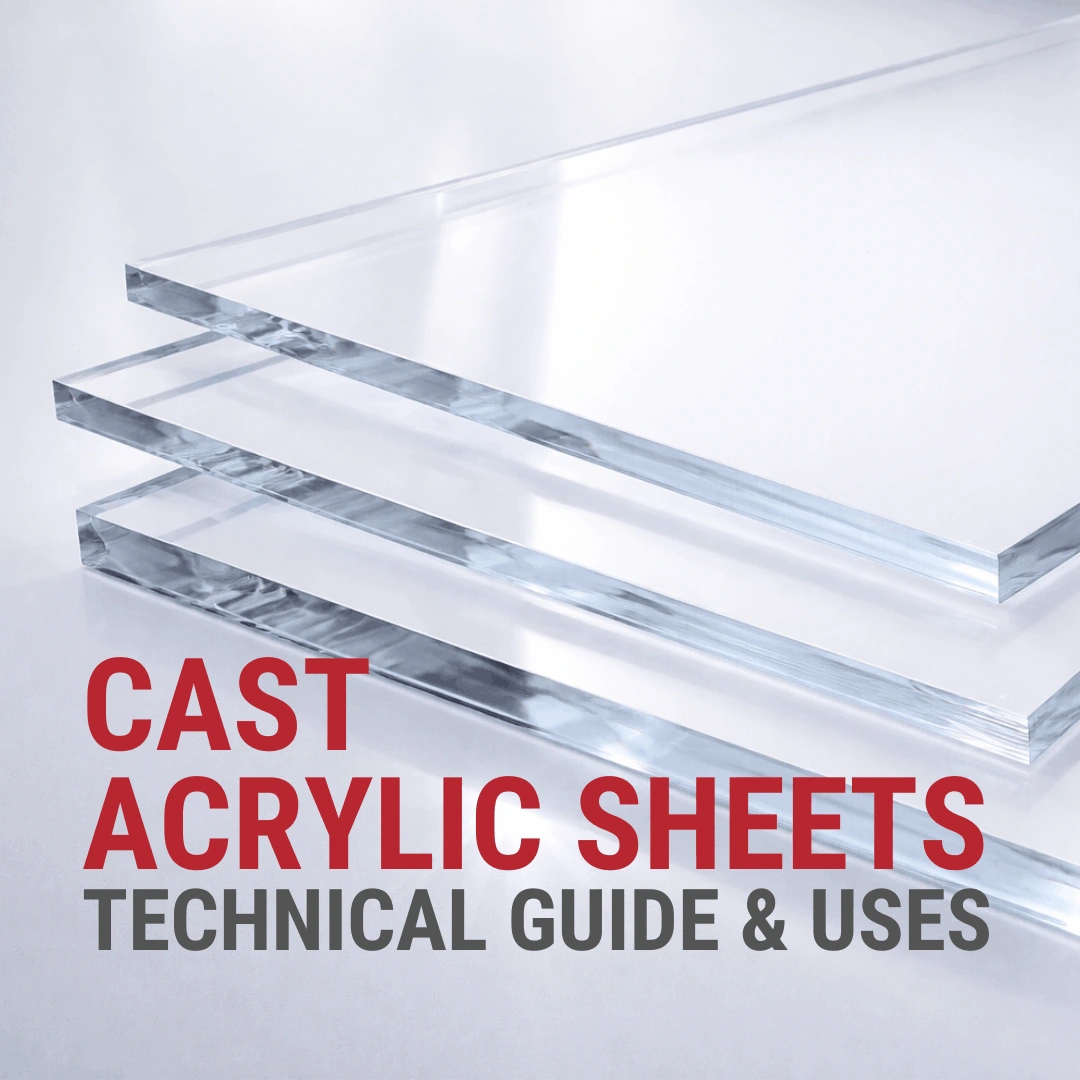
Not all acrylic is created equal. If you’ve ever dealt with crazing, chipped edges, or melted material during machining, you’ve probably run into the limits of extruded acrylic. For fabricators, engineers, and procurement specialists who need consistent results, knowing when to specify cell cast and when extruded will do the job is the difference between a clean run and a scrap pile.
Acrycast is a premium cell cast acrylic sheet distributed exclusively in the United States by Calsak Plastics. The cell casting process delivers stress relief, optical clarity, and chemical resistance that matter in demanding applications. Whether you’re fabricating aquarium viewing panels, precision-machined components, or outdoor signage that has to last, cell cast acrylic gives you performance extruded sheet can’t consistently match.
It’s also more expensive, and it isn’t the right answer for every job. This guide covers both sides.
See Acrycast cell cast acrylic sheet specifications and sizes
Cell Cast vs. Extruded Acrylic: Quick Comparison
Quick answer: Cell cast acrylic is poured between glass panes and cured slowly, producing a higher molecular weight, stress-relieved sheet that machines cleanly and resists chemicals. Extruded acrylic is pushed continuously through heated rollers, producing a lower-cost sheet with tighter thickness tolerance that cements and thermoforms faster. Specify cast for machining, thick gauges, and chemical exposure. Specify extruded for cost, thin-gauge consistency, and high-volume forming.
| Factor | Cell Cast (Acrycast) | Extruded |
|---|---|---|
| Manufacturing | Monomer cast between glass, cured in an autoclave | Continuous extrusion through heated rollers |
| Molecular weight | Higher | Lower |
| Machining | Less tendency to melt or chip | More prone to chipping and gumming |
| Thickness tolerance | Looser | Tighter |
| Thickness range | Wider, including gauges above 1″ | Limited to thinner gauges |
| Optical distortion | Less low-angle distortion | More noticeable in thicker gauges |
| Sheet cleanliness | More prone to particulate inclusions | Less dirt, lint, and contamination |
| Chemical resistance | Slightly better | Slightly more prone to solvent crazing |
| Thermoforming | Better hot strength and detail retention | Forms faster |
| Solvent cementing | Stronger joints, less crazing risk | Cements faster |
| Service temperature | Slightly higher | Slightly lower |
| Custom colors / low MOQ | Yes, low minimum runs | Longer production runs required |
| Cost per square foot | Higher | Lower |
Comparison based on manufacturer guidance from Röhm GmbH for ACRYLITE cast and extruded acrylic sheet. See the source comparison.
What Is Acrycast? Understanding Cell Cast Acrylic Manufacturing
Acrycast is a branded line of cell cast acrylic sheet distributed exclusively in the U.S. by Calsak Plastics. It’s made by a fundamentally different process than commodity extruded acrylic, and that difference drives everything else on this page.
Cell Cast vs. Extruded: The Manufacturing Difference
Cell cast production pours liquid monomer between two panes of polished glass separated by a gasket that sets the sheet thickness. Each sheet needs its own gasketed glass cell assembled by hand. The cells go into an autoclave to react and cure, then the glass is separated and the sheet is inspected for clarity and thickness. It’s labor intensive, which is a large part of why cast acrylic costs more.
Extruded acrylic runs continuously through heated rollers. The process uses extrusion-grade polymers with lower molecular weight than the polymer produced by cell casting. It’s faster, cheaper, and holds thickness more consistently, but the lower molecular weight and the residual stress from forming show up later during machining and solvent exposure.
The Stress-Relief Advantage
Cell cast material cures without the mechanical forces that lock stress into extruded sheet. For fabricators that translates into three practical benefits:
- Cleaner machining: CNC routing and drilling show less tendency to melt or chip the edge
- Better chemical resistance: less prone to crazing when exposed to adhesives, solvents, and cleaning agents
- Load performance: better capability under long-term mechanical loads and continuous water contact
These are real differences, not absolutes. Extruded acrylic machines perfectly well with sharp carbide tooling and a correct feed rate. Cast acrylic simply gives you more margin when conditions aren’t ideal.
Where Extruded Acrylic Is the Better Choice
A comparison that only lists one material’s strengths isn’t much use at a spec meeting. Extruded acrylic wins on four counts, and on the right job those wins matter more than anything cast offers.
- Cost. Lower price per square foot, and the gap widens across a large order.
- Thickness tolerance. Extruded holds tighter gauge consistency than cell cast. If your part stacks, nests, or slots into a fixed channel, that consistency is worth more than molecular weight.
- Sheet cleanliness. Extruded sheet carries less dirt, lint, and particulate contamination, which matters for backlit panels and display work where an inclusion is a reject.
- Speed in forming and bonding. Extruded acrylic cements and thermoforms faster, which shortens cycle times on production runs.
For thin-gauge signage, POP displays, glazing replacement, and high-volume formed parts, extruded is frequently the correct specification. Paying for cast on those jobs is money spent on performance the application never uses.
Acrycast Technical Specifications
Optical Properties
- Light transmission: 92%
- Refractive index: 1.49
- Clarity: less low-angle distortion than extruded, particularly in thicker gauges
- Applications: aquarium viewing panels, optical instruments, lighting diffusers
Chemical Resistance
Cell cast acrylic offers slightly better chemical resistance than extruded, and handles exposure to:
- Diluted acids and alkalis
- Aliphatic hydrocarbons
- Most mild cleaning solvents
- Solvent adhesives and bonding agents, with lower crazing risk
Acrylic of either type is attacked by acetone, chlorinated solvents, gasoline, and denatured alcohol. Confirm compatibility against the manufacturer’s chemical resistance chart before standardizing a cleaning protocol.
Weatherability and UV Stability
- Outdoor durability: acrylic is inherently UV stable and resists yellowing over years of exposure. This applies to both cast and extruded acrylic, and is a genuine advantage over polycarbonate rather than over extruded sheet.
- UV transmission: specific grades can be specified to block UV-B or transmit UV-A depending on the application
- Color stability: maintains appearance in architectural installations
Mechanical Properties
- Tensile strength: 10,000+ PSI
- Impact resistance: roughly 17 times that of glass. Cast and extruded acrylic have broadly comparable impact performance. If impact is the governing requirement, specify an impact-modified acrylic grade or polycarbonate rather than choosing between cast and extruded.
- Service temperature: slightly higher than extruded
- Machinability: excellent across routing, drilling, and polishing
Need Acrycast technical data sheets for your specific application? Contact your nearest Calsak branch for specification support and engineering assistance.
Fabrication: Machining, Thermoforming, and Edge Finishing
CNC Machining and Routing
Cast acrylic’s higher molecular weight gives it less tendency to melt or chip during machining. In practice that means fewer chipped edges, less material welding itself back into the kerf, and less finishing work downstream.
Tooling still matters more than material choice. Keep bits sharp, use carbide, and give chips somewhere to go. A dull bit will chip cast acrylic just as readily as extruded.
Laser Cutting
Both types laser cut well, but they finish differently. Extruded acrylic typically produces the glossier, more transparent laser edge. Cast acrylic laser cuts to a characteristic frosted, matte edge, which is often the desired look for engraved signage and awards but is not what you want on a display panel edge. Choose based on the finish you’re after.
Thermoforming
Extruded acrylic thermoforms faster and at a lower temperature, which shortens cycle times on production runs. Cast acrylic has better hot strength, holds detail through deeper draws, and shows less thickness variation across a formed part. Prototype and low-volume optical work generally favors cast. High-volume shallow forming generally favors extruded.
Edge Finishing
Cast acrylic machine polishes to a cleaner finish and takes solvent cementing with less crazing risk, which is why it’s specified for bonded assemblies and visible-edge work.
One caution on flame polishing, regardless of which sheet you use: manufacturer fabrication guidance advises against it as a general finishing method, because it leaves the polished area in a highly stressed condition that can cause crazing or failure later. Sanding and buffing is the recommended route. Where flame polishing is unavoidable for areas buffing can’t reach, anneal the part afterward to relieve the stress.
Acrycast N2: Military and Aerospace Grade Cell Cast Acrylic
For applications with the highest performance requirements, Acrycast N2 is the premium tier. This grade meets stringent military and aerospace specifications and also serves high-specification commercial projects.
View Acrycast N2 technical specifications and applications
Acrycast N2 Applications
- Military aircraft: canopy and windscreen components requiring optical clarity and impact resistance
- Aerospace instrumentation: panel covers and protective barriers
- Marine: submarine viewports and deep-water observation equipment
- High-security installations: ballistic-rated glazing and detention facility windows
Acrycast N2 keeps the core advantages of standard Acrycast while meeting additional quality control standards. Procurement teams sourcing cell cast aquarium acrylic for public aquarium projects and marine research facilities often specify N2 for its documented compliance.
Applications: Where Cell Cast Acrylic Earns Its Premium
Aquariums and Water Features
Cell cast acrylic is the industry standard for large aquarium viewing panels, and the reasons are specific. Cast acrylic is more suitable for continuous contact with water and has better capability under long-term mechanical loads, which is exactly what a panel under constant hydrostatic pressure needs. It also supports seamless chemical welding for leak-proof joints and resists crazing from cleaning chemicals and salt water.
Public aquariums, marine research facilities, and high-end residential installations specify cast when panel failure isn’t survivable.
Thick-Gauge and Machined Components
Extruded acrylic isn’t produced in heavy plate. Once your part calls for gauges above roughly one inch, cast is effectively the only option. Combine that with cleaner machining behavior and cast becomes the default for machined blocks, manifolds, and structural components.
Outdoor Signage and Architectural Applications
Acrylic holds up outdoors in either form. Cast earns its place in architectural work through custom color availability at low minimum order quantities, less low-angle distortion in large glazing panels, and slightly higher service temperature behind illuminated faces.
- Building facades: decorative panels and cladding
- Illuminated signage: channel letters and backlit displays
- Transit shelters: durable glazing for bus stops and rail platforms
- Retail displays: window graphics and point-of-purchase fixtures
Sourcing Acrycast
Calsak Plastics is the exclusive U.S. distributor of Acrycast cell cast acrylic. Whether you need stock sheet sizes for a fabrication shop or custom dimensions for an OEM production run, Calsak’s program includes:
- Thickness range: see the Acrycast product page for current stocked gauges, or ask your branch about heavy plate
- Standard and custom sizes: stock sheets plus cut-to-size and fabrication services
- Color options: clear, translucent, opaque, and custom color matching at low minimum runs
- Grade selection: standard Acrycast and premium Acrycast N2
- Technical support: material selection and fabrication guidance from all seven U.S. branches
Making the Right Material Choice
The decision usually comes down to application requirements and total project cost, not sheet price. Extruded acrylic costs less per square foot, and that saving holds up on plenty of jobs. It stops holding up when a project requires:
- Precision machining where chipping and melting drive scrap
- Solvent bonding or exposure to aggressive cleaning agents
- Thick sheet gauges above roughly one inch
- Continuous water contact or sustained mechanical load
- Custom colors at low order quantities
- Minimal optical distortion in large or thick panels
Conversely, if you’re running thin-gauge sign faces at volume, need tight thickness consistency, or are thermoforming shallow parts on a tight cycle time, extruded is the better specification and cast is an unnecessary premium.
Frequently Asked Questions About Cell Cast and Extruded Acrylic
What is the difference between cell cast and extruded acrylic?
Cell cast acrylic is made by pouring liquid monomer between two panes of polished glass and curing it slowly in an autoclave, producing a higher molecular weight, stress-relieved sheet. Extruded acrylic is pushed continuously through heated rollers using lower molecular weight extrusion-grade polymer. Cast offers less tendency to melt or chip during machining, slightly better chemical resistance, a wider thickness range, and less low-angle distortion. Extruded offers lower cost, better thickness tolerance, less particulate contamination, and faster cementing and thermoforming.
Is cell cast acrylic better than extruded acrylic?
Neither is universally better. Cell cast is the right specification for machined parts, thick gauges above one inch, chemical exposure, continuous water contact, and custom colors at low order quantities. Extruded is the right specification for cost-sensitive work, thin-gauge parts needing tight thickness tolerance, backlit panels where sheet cleanliness matters, and high-volume thermoforming where cycle time drives cost. Specifying cast for a job that doesn’t need it is money spent on performance the application never uses.
Which acrylic has better thickness tolerance, cast or extruded?
Extruded acrylic holds better thickness tolerance than cell cast. The continuous extrusion process produces more consistent gauge across the sheet, while cell casting depends on gasket thickness and cure behavior and varies more. If a part has to nest, stack, or slot into a fixed channel, extruded acrylic’s gauge consistency can matter more than cast acrylic’s other advantages.
Why does cell cast acrylic machine better than extruded acrylic?
Cell cast acrylic’s higher molecular weight and stress-relieved structure give it less tendency to melt or chip during routing, drilling, and cutting. Extruded acrylic contains residual stress from the roller forming process, which makes it more prone to edge chipping, material buildup on cutting bits, and star-cracking around drilled holes. The difference is one of margin rather than absolutes. Extruded acrylic machines cleanly with sharp carbide tooling and correct feed rates, but cast is more forgiving when conditions are less than ideal.
Which acrylic laser cuts better?
They laser cut differently rather than one being better. Extruded acrylic typically produces a glossier, more transparent laser-cut edge, which suits display panels and visible edges. Cast acrylic laser cuts to a frosted, matte edge, which is often the preferred look for engraved signage, awards, and edge-lit pieces. Choose based on the edge finish the application calls for.
Which acrylic is better for thermoforming?
It depends on the part. Extruded acrylic thermoforms faster and at lower temperature, which shortens cycle times on production runs of shallow parts. Cell cast acrylic has better hot strength, holds detail through deeper draws, and shows less thickness variation across the formed part, which makes it the better choice for optical components, deep draws, and prototype work where dimensional accuracy matters more than cycle time.
Does cell cast acrylic resist chemicals better than extruded?
Slightly, yes. Cell cast acrylic’s stress-relieved structure makes it less prone to stress crazing when exposed to solvent adhesives, diluted acids and alkalis, and cleaning agents. Extruded acrylic’s residual internal stress makes crazing more likely under the same exposure. Both materials are attacked by acetone, chlorinated solvents, gasoline, and denatured alcohol, so confirm compatibility against the manufacturer’s chemical resistance chart before standardizing on a cleaning product.
Is cell cast acrylic more impact resistant than extruded acrylic?
No meaningful difference. Both cast and extruded acrylic offer roughly 17 times the impact resistance of glass, and impact performance is not where the two processes differ. If impact resistance is the governing requirement for your application, specify an impact-modified acrylic grade or move to polycarbonate rather than choosing between cast and extruded.
Does extruded acrylic yellow faster than cast acrylic?
No. Acrylic is inherently UV stable as a polymer class, and both cast and extruded acrylic resist yellowing through years of outdoor exposure. Resistance to yellowing is a genuine advantage of acrylic over uncoated polycarbonate, not an advantage of cast acrylic over extruded. Specify UV-filtering or UV-transmitting grades based on what the application needs to do with UV wavelengths, not on cast versus extruded.
Why is cell cast acrylic required for aquarium applications?
Cell cast acrylic is more suitable for continuous contact with water and has better capability to handle long-term mechanical loads, which is precisely what an aquarium viewing panel under constant hydrostatic pressure requires. It also supports seamless chemical welding for leak-proof joints, resists crazing from cleaning chemicals and salt water, and is available in the heavy gauges large panels demand. Extruded acrylic is not produced in the thicknesses these panels need.
What is Acrycast N2 and when should it be specified?
Acrycast N2 is a premium-grade cell cast acrylic that meets stringent military and aerospace specifications while also serving high-specification commercial applications. It maintains the core advantages of standard Acrycast while meeting additional quality control standards. Specify Acrycast N2 for military aircraft canopies, aerospace instrumentation panels, submarine viewports, ballistic-rated glazing systems, and public aquarium installations where material failure is not acceptable and documented compliance is required.
Is cell cast acrylic more expensive than extruded acrylic?
Yes. Cell casting is labor intensive because each sheet requires its own gasketed glass cell to be assembled and separated, so cast acrylic costs more per square foot. That premium is worth paying when a project needs precision machining, solvent bonding, thick gauges, continuous water contact, or custom colors at low order quantities, because it reduces scrap and finishing time. On thin-gauge, cost-sensitive, high-volume work, extruded delivers what the application needs for less.
Where can I buy Acrycast cell cast acrylic sheet?
Calsak Plastics is the exclusive U.S. distributor of Acrycast cell cast acrylic, stocking and shipping from seven U.S. branches. Calsak offers stock sheet sizes, cut-to-size service, custom dimensions for OEM production runs, custom color matching at low minimum quantities, and technical support for material selection and fabrication. Contact your nearest branch for current stocked gauges, sizes, and pricing.
Specify the Right Acrylic for Your Next Project
Cell cast acrylic earns its premium when fabrication quality, chemical exposure, thick gauges, or long-term load performance drive the specification. Extruded earns its place when cost, gauge consistency, and forming speed matter more. Knowing which job you have in front of you is most of the work.
Not Sure Which Acrylic Your Project Needs?
Talk to a Calsak technical specialist for material recommendations, cut-to-size service, and Acrycast pricing.
Whether you’re fabricating a single prototype or sourcing material for production runs, our team helps you specify the right sheet the first time.
Sources
- Röhm GmbH / POLYVANTIS. What is the difference between cast and extruded acrylic sheet? ACRYLITE Knowledge Base. acrylite.co
- Plaskolite, LLC. OPTIX-L Continuous Cast Acrylic Sheet Fabrication Guide (2024). plaskolite.com
Property values are typical for general-purpose clear grades and vary by manufacturer, grade, and thickness. Confirm figures against the current technical data sheet and with your Calsak branch before specifying.

Leave a Reply